
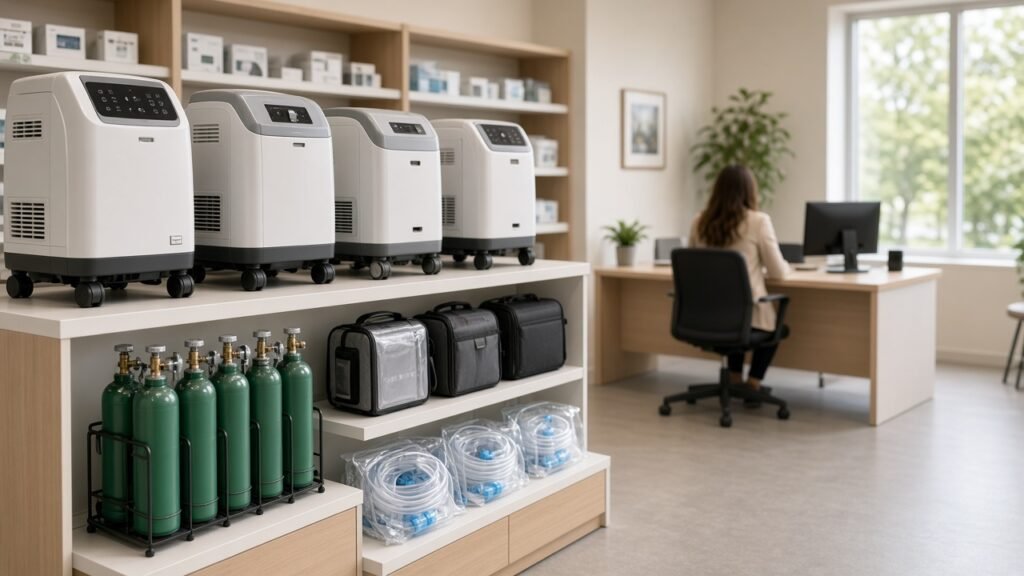
Month 36 is where a lot of oxygen revenue quietly goes wrong. The rental payments stop, the patient is still on oxygen, and the account drops off everyone’s radar. Six months later someone notices that contents were never billed, or that a driver swapped a concentrator and the team started a fresh rental that Medicare will take back.
If you read our post on capped rental billing, you already know oxygen doesn’t follow the 13-month rule. It has its own track: 36 months of rental, then a five-year lifetime that keeps you on the hook long after the checks slow down. This post covers what happens in months 37 through 60, what you can still bill, and what you’re still required to do.
The rules below come from 42 CFR 414.226, LCD L33797 (Oxygen and Oxygen Equipment) and its policy article, A52514.
The two clocks: 36 months and 60 months
There are two dates to track on every oxygen patient, and mixing them up causes most of the trouble.
The rental cap. Medicare pays the monthly rental for oxygen equipment for no more than 36 months of continuous use. After the 36th paid month, there is no further payment for the equipment itself.
The reasonable useful lifetime (RUL). The RUL for oxygen equipment is five years. It starts on the initial date of service and runs for five years from that date. It isn’t tied to the age of the actual machine. Swapping a concentrator, changing suppliers or switching from a concentrator to liquid doesn’t reset it.
If stationary and portable started on different dates, the stationary RUL governs both.
So months 37 to 60 are the stretch where you’re getting no rental payment but still own every obligation that comes with the patient.
What you’re required to keep doing in months 37 to 60
The supplier who billed the 36th rental month has to keep furnishing the equipment for as long as the patient needs it, until the RUL ends. Per A52514, that means the equipment, accessories, contents (if the patient is on gaseous or liquid oxygen), maintenance and repairs.
Accessories such as cannulas, tubing and regulators stay bundled, with no separate payment after the cap, but you still supply whatever the practitioner orders.
What you can still bill
Oxygen contents
This is the line that gets missed most. During the rental period, contents are included in the stationary equipment payment. No contents can be paid in a month where stationary equipment is paid. Once the stationary rental ends, contents can become separately payable:
- Patient on a stationary gaseous or liquid system in the 36th month: stationary contents (E0441 or E0442) start when the stationary rental ends.
- Patient using portable gaseous or liquid equipment in the 36th month of the stationary rental (even if the stationary unit is a concentrator): portable contents (E0443, E0444 or E0447) start when the stationary rental ends.
- Patient on both stationary and portable gaseous or liquid equipment: both stationary and portable contents start.
- Patient on a stationary concentrator, portable liquid, and a stationary liquid tank used only to fill the portables: only portable liquid contents are paid.
- Patient on a concentrator only: no contents to bill, unless a practitioner later orders a switch to gaseous or liquid.
A few billing limits apply. You can bill no more than one unit of stationary contents and one unit of portable contents per month. You can deliver no more than three months of contents at one time. The contents payment doesn’t change for flow rates above 4 LPM or below 1 LPM. LCD L33797 also notes that contents are a monthly allowance and aren’t subject to the Chapter 5 refill monitoring rules that apply to other recurring supplies, but billing still has to be prospective, not retrospective.
Portable equipment that started later
If portable equipment (E0431, E0433, E0434, E1392 or K0738) started after the stationary equipment, the portable rental keeps paying after the stationary rental ends, until the portable item reaches its own 36 rental payments. Don’t stop billing a portable just because the stationary capped out.
Maintenance and servicing visits
During the first 36 months there’s no separate payment for maintenance and servicing. In months 37 to 60, if the patient was using a stationary concentrator, portable concentrator or transfilling equipment in the 36th month, Medicare pays for one maintenance and servicing visit no more often than every six months, starting no sooner than six months after the rental period ends.
The conditions matter:
- If a warranty covers routine maintenance labor, the first payable visit is no sooner than six months after the warranty ends.
- A technician has to actually go out. You can’t bill a visit that didn’t happen.
- Only one visit is paid per six-month period, however many you make.
- There’s no maintenance payment for gaseous or liquid equipment.
What does not start a new rental
This is where overpayments come from. Under A52514, a new 36-month rental period during months 37 to 60 can start only when there’s a specific incident of damage beyond repair (dropped and broken, fire, flood) or the item is stolen or lost.
A new rental does not start when you:
- Replace equipment for malfunction, wear and tear, routine maintenance or repair
- Switch equipment on a practitioner’s order or because the patient wants an upgrade
- Have a break in need or a break in billing
- Take over the patient from another supplier
For breaks: a hospital stay, SNF stay or time in a Medicare Advantage plan while the patient still needs oxygen doesn’t reset anything. During months 37 to 60, even a break in need longer than 60 days plus the rest of the rental month doesn’t start a new rental period. The supplier from month 36 still owes everything through the end of the RUL.
When replacement for damage, theft or loss is legitimate, the first rental month of the new period needs the RA modifier, a narrative explaining why the equipment was replaced, a new practitioner order reaffirming medical necessity, and supporting documentation in your file. Only the first month carries RA.
Month 61 and after
Once the five-year RUL ends, the patient can choose new equipment at any time, and that starts a new 36-month rental. The new period is billed like a fresh start, including the RA modifier on the first month and the order.
If the patient doesn’t want new equipment, what happens depends on who holds title:
- You keep title: the months 37 to 60 rules continue. No payment for accessories or repairs, contents still payable for gaseous or liquid patients, and maintenance visits under the same terms.
- You transfer title to the patient: accessories, maintenance and repairs become non-covered. Contents for a patient-owned gaseous or liquid system are still separately payable.
Document which path the patient chose.
When the patient moves
In months 37 to 60, if the patient relocates outside your service area, whether for short-term travel, an extended temporary stay or a permanent move, you have to either keep providing the equipment and services yourself or arrange for another supplier to do it. That’s how 42 CFR 414.226(h) is written, and it applies to contents too.
Because changing suppliers doesn’t start a new rental, the receiving supplier inherits a patient with no equipment rental left to bill.
Common mistakes we see
- Contents never start. The rental ends, the billing system stops the recurring line, and nobody adds E0441 to E0444 or E0447.
- Billing contents in a month the stationary rental still paid. That’s an automatic denial.
- Restarting the rental after a swap for a worn-out unit or a modality change.
- Billing maintenance without a visit, before the six-month mark, or more than once in six months.
- Losing the RUL date when a patient transfers in, so nobody knows when month 61 arrives.
A month-36 checklist
Run this on every oxygen patient approaching the cap:
- Confirm the initial date of service and calculate the RUL end date.
- Confirm the stationary and portable start dates. If the portable started later, keep its rental going until its 36th payment.
- Record exactly what equipment the patient had in month 36: concentrator, gaseous, liquid, transfill, portable concentrator.
- Set up the right contents codes to start the month after the stationary rental ends.
- For concentrator and transfill patients, schedule the first maintenance visit no sooner than six months after the rental ends, or after the warranty ends if it covers maintenance labor.
- Flag the account so swaps and modality changes don’t trigger a new rental unless there’s documented damage beyond repair, theft or loss.
- Thirty to sixty days before the RUL ends, decide the month 61 plan: replacement, keep title, or transfer title.
- For any move out of your area, document how equipment and contents will be handled and by whom.
Get a second look at your oxygen accounts
You can see how we handle oxygen billing and the rest of our DME billing services.
Want to know if your oxygen accounts line up with the rules?
Salyx RCM’s free billing audit is a good place to start. We check whether your contents, portables and maintenance visits match the rules.